

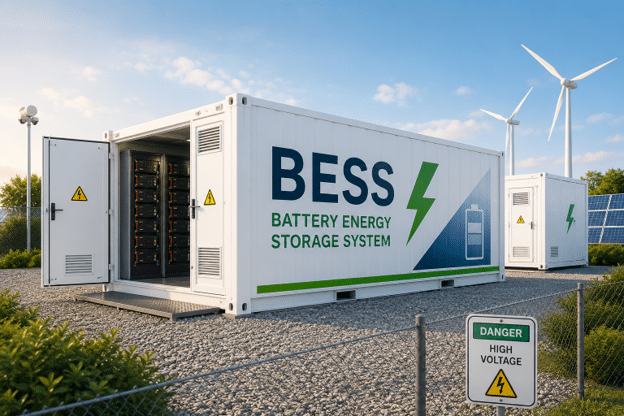
Renewable energy has a fundamental challenge that everyone knows but is less talked about. The wind stops. The sun sets. Because of this, we are left with a massive mismatch between when clean electricity is actually generated and when it is used. That is where battery energy storage systems (BESS) step in. They are not a luxury or a future concept. Clean energy companies in India consider them as the exact bridge needed to turn unpredictable green energy into a reliable, 24/7 reality.
Flattening the Duck Curve
Grid operators are worried about the ‘duck curve’. It is a simple, frustrating reality: midday solar generation causes net electricity demand to drop off a cliff but the moment the sun goes down, demand spikes massively. To deal with that sudden evening surge, utilities historically had to fire up highly polluting fossil-fuel peaker plants. A BESS completely changes this setup. It drinks up excess solar or wind energy during peak afternoon production hours, storing it away for later. Instead of letting energy go to waste, a BESS ensures that every single kilowatt-hour is saved and deployed exactly when the grid is under the heaviest strain.
How the Tech Stabilises the Grid
A BESS is not just a giant pile of batteries thrown together. It is a smart setup that links battery modules to an intelligent battery management system (BMS), a power conversion system (PCS), and specialised software. Together, they keep the power grid stable using three main methods:
- Instant Frequency Control: Power grids require a precise balance between supply and demand. Old gas turbines take time to spin up but a BESS can inject or absorb power in milliseconds to fix sudden drops.
- Peak Shaving: By dumping stored electricity into the network during peak hours, batteries flatten the demand spikes. This stops infrastructure from overloading and lowers costs for consumers.
- Black Start Support: If a storm knocks the entire grid out, a BESS can provide the initial electrical spark required to boot up main power stations from scratch.
Real Autonomy for Factories and Businesses
This is not just for massive utility companies. Commercial and industrial sectors are spending heavily on on-site battery storage right now. For factories or data centres, even a brief power cut causes chaotic financial losses. Linking a BESS with on-site solar panels gives businesses real energy security. If the main grid goes down, the batteries take over immediately. On top of that, businesses can play the market — charging their batteries when electricity rates are dirt cheap, then running off battery power when peak tariffs skyrocket.
The Reality Check
BESS is not perfect yet. Lithium-ion still dominates the market but supply chain bottlenecks and safety concerns mean the industry has to pivot. Because of this, we are seeing a fast shift toward sodium-ion and flow batteries, which offer longer lifespans for stationary storage.
The Bottom Line
Storage cannot be treated as an optional add-on. If renewable energy is the engine driving the transition to net-zero for BESS is the actual gearbox that makes the vehicle move. By fixing the issue of intermittency, renewable energy companies in India are transforming green energy from a nice idea into a practical reality.
| Disclaimer: The information provided in this blog is for general informational purposes only and not professional advice. Jakson Green Limited bears no responsibility for errors, omissions or the accuracy of the information provided. |

