Water stress has come up as one of the most pressing and structural issues for the Indian development state. The dual forces of India’s population growth and growing Indian industries, along with the impact of climate change, have created unprecedented pressures on the already scarce water resources of the country. As 18 percent of the world’s population is met by just four percent of the world’s water, the water situation for India is no longer episodic; it is systemic.
Today, in India, nearly 600 million Indians are affected by high to extreme water stress. Rivers are over-extracted, water tables are falling at alarming levels, and water pollution is ongoing. These effects are not limited by area, touching almost all domains, including the effects that water can have upon humans, agriculture, economy, and inequality. Coastal regions like Chennai, Mumbai, and Gujarat are also affected by another phenomenon, that of saline water intrusion into water tables due to excessive groundwater extraction, making them unfit for human or agricultural use.
Why desalination matters for India
Desalination: In this scenario, there has emerged recognition of desalination not merely as an “effort of last resort in managing water crises” but rather as one of several pillars of sustainable water security in the future. Desalination of seawater and seawater of high salt content consists of several processes aimed at finding an efficient way to remove salt and various contaminants to obtain freshwater suitable for drinking, irrigation, and industrial use. For a nation that spans in length over 7,500 km of coastline, having such an enormous water source that relies neither on weather nor climate change patterns might seem extremely enticing.
Historically, desalination received criticism owing to its large energy consumption and cost. Yet, improvements made in membrane technology, efficiency, and use of renewable energy sources have dramatically shifted emphasis away from these criticisms. The current state of desalination is much cleaner, efficient, and much more responsive to water demands in India.
Reverse osmosis and advanced membranes
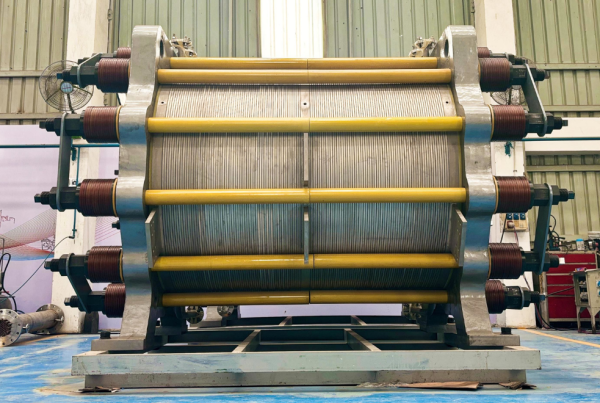
Most modern desalination plants are based on the principle of reverse osmosis. In RO, pressurised seawater flows through semi-permeable membranes that allow water molecules to pass but reject salts, bacteria, and other impurities. Advances in membrane materials have steadily improved salt rejection rates while minimising both fouling and energy consumption.
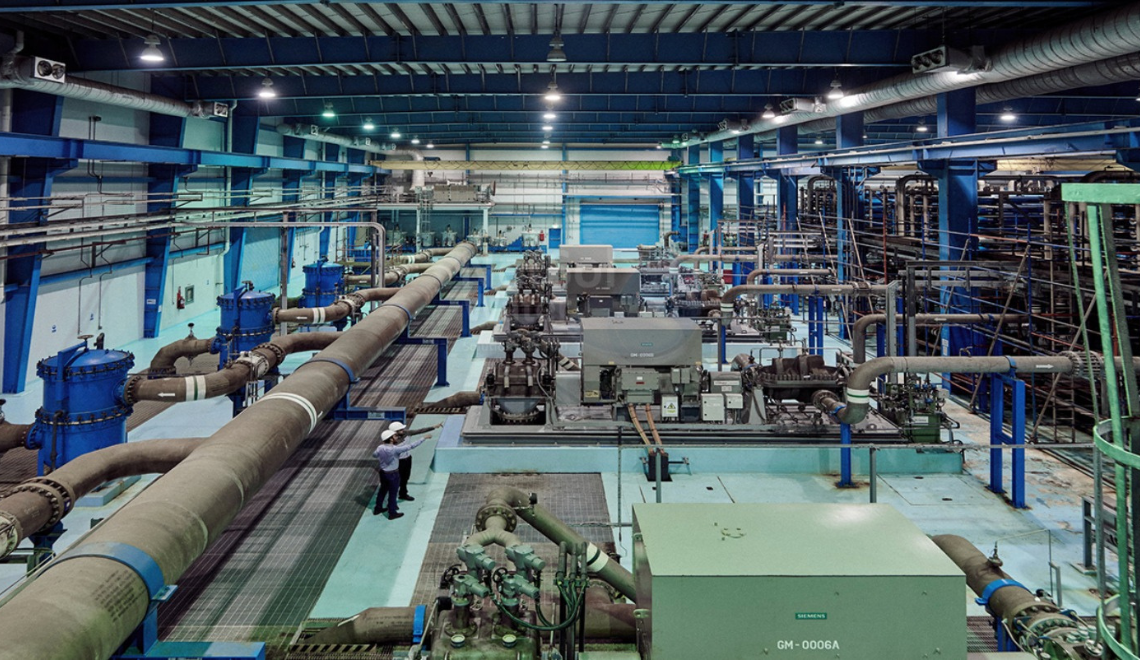
These next-generation membranes are more long-lasting and need to be replaced less often, hence resulting in lower lifecycle costs. As a result, RO-based desalination has become the backbone of large-scale projects in India’s coastal regions, delivering consistent, high-quality water for urban supply, agriculture, and industry.
Renewable energy integration and energy efficiency
The most revolutionary change taking place in desalination is the use of renewable energy inputs. Solar- and wind-powered desalination plants have minimised the dependence on fossil fuels. In regions of western and southern India where there is ample sunlight available, solar-powered RO plants are being found to be a viable alternative.
Integration of renewables makes possible the establishment of a decentralised sea water desalination process, which refers to the design of smaller plants that could be set up for the purpose of serving villages, islands, and industries, among others, that are far from the mainstream water infrastructure due to geographical reasons and are, therefore, inaccessible due to the distance and costs involved.
Modular and scalable solutions
Modern desalination plants are becoming much more modular and scalable. Small plug-and-play desalination plants can be quickly deployed and scaled up depending on the size of the community being served. They are much preferable from both financial and logistical viewpoints. They have a small footprint, are easier to install, and offer flexibility depending on the required capacity.
In reducing the dependence on the over-exploited water resources of the rivers and the groundwater, the desalination of water brings about the regulation of the water systems of India, as it also promotes the development of the country in terms of the growth of the
Breakthrough innovations beyond conventional desalination
In addition to known RO technologies, new innovations are also shaping the future of desalination processes. One such innovation is a siphon-based thermal desalination model designed by scientists at the Indian Institute of Science. This innovation not only solves one of the problems associated with traditional sun-powered desalination, salt accumulation, but also relates to scalability.
Employing a composite siphon consisting of a fabric wick with a grooved metal surface, the apparatus promotes a continuous flow of water while concurrently flushing out salt deposits before they form into salt crystals. A layer of sea water is drawn to a hot surface, turns into vapour, and then forms in condensed form in an ultrathin layer of air, thereby enhancing efficiency. It is capable of producing more than six liters of distilled water per hour per square meter in sunlight, far exceeding regular solar stills.
This innovation is low-cost, scalable, and operates well in highly saline water. It has the capacity to work using solar energy or waste heat. This technology can easily operate in off-grid zones, zones of natural disasters, island, and arid zones along the coast.
A strategic path forward for water security
The water situation in India can’t be managed by water conservation or the augmenting traditional method alone. It requires a multi-track method with the leading role by the desalination process. By using innovative membrane materials, renewable energy sources, the modulated method, and innovative solutions, the process is moving from being an expensive solution to the required one.
As policy support, investment, and technology readiness continue to fall in place, desalination stands to change the future of water in India and assure these waters as an important source of mitigation, growth, and sustainable water security in this region.